
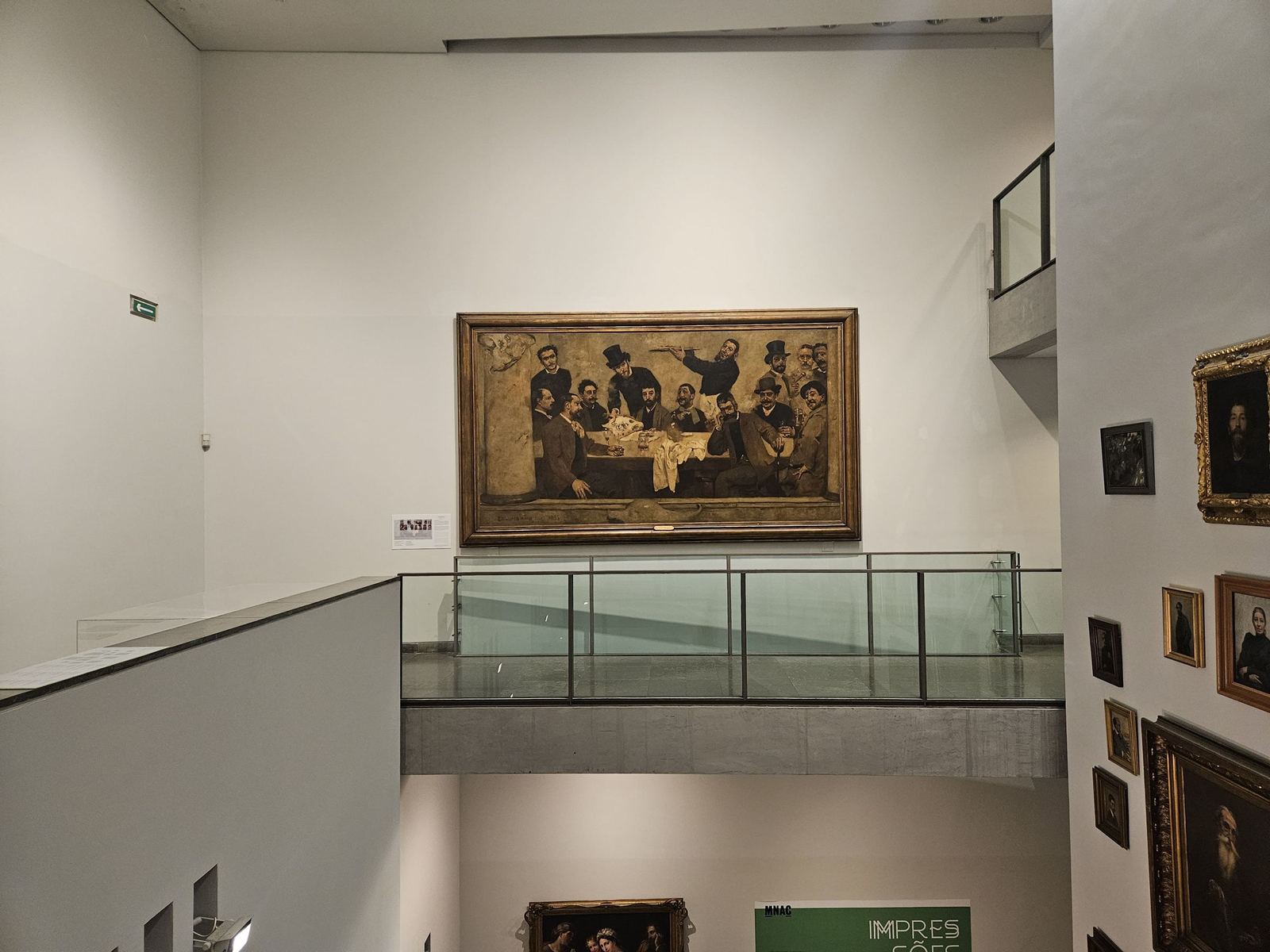
Come closer. They are talking.
O Grupo do Leão
Columbano Bordalo Pinheiro, 1885 · oil on canvas, 376 × 201 cm
National Museum of Contemporary Art (Chiado), Lisbon
For more than a century, the fourteen people in this painting have been silent. Here, your body is the interface: walk along the painting and come closer to hear the conversations of the Leão d'Ouro brewery.
- Sound in Portuguese, English captions
- About 4 minutes
- Keyboard, mouse or touch
- Touch
About the project
The research
Appreciating art is not innate.
A work of art only makes sense to those who hold the code to read it, wrote Bourdieu; those who don’t feel “drowned” in a chaos of colours and lines. And in art museums, it is almost always the institution that tells the story, on a fixed wall label, while the visitor only looks.
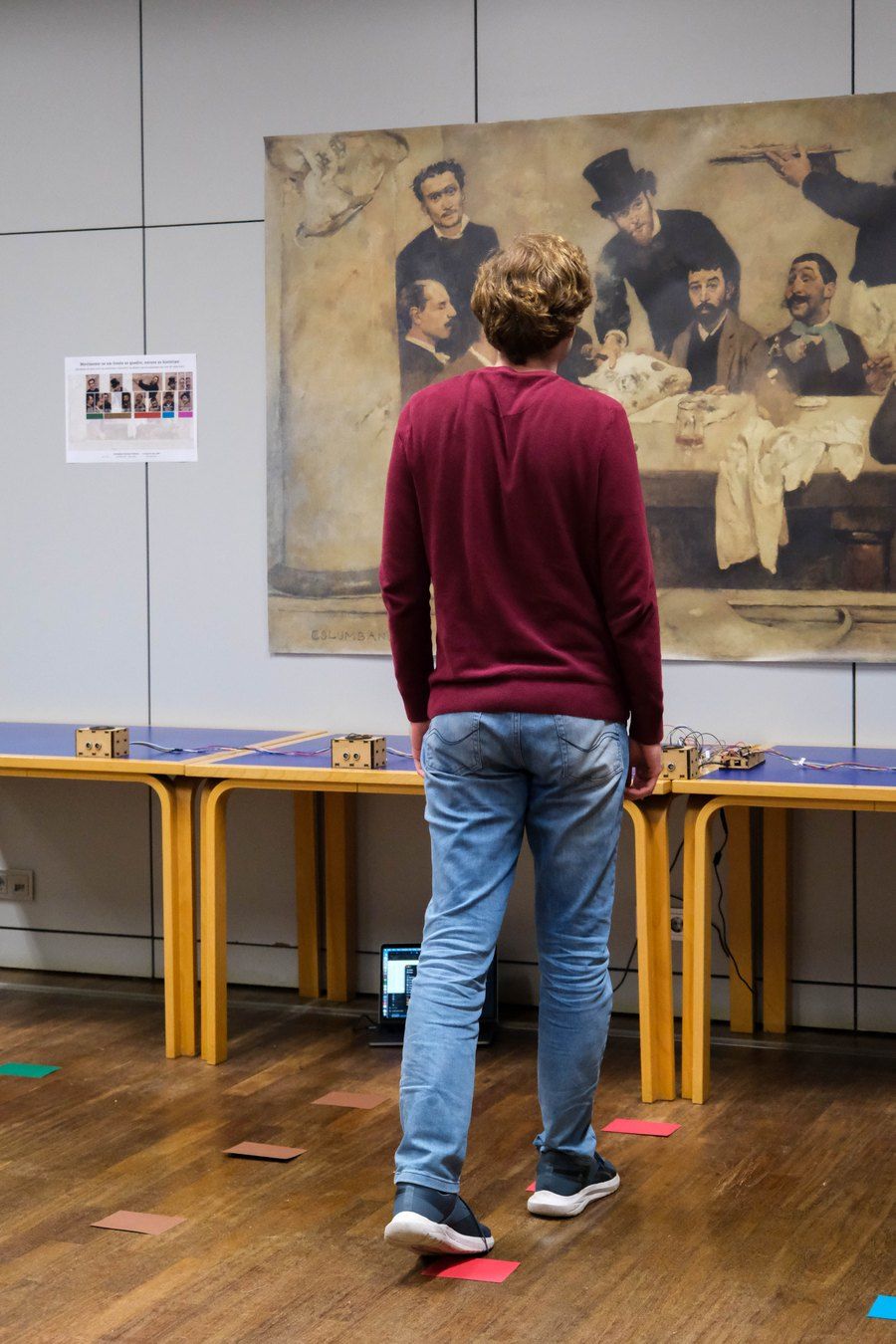
This Master’s project in Interaction Design started there. Instead of putting screens in front of the work or projecting it onto the walls, the painting stays untouched and the people in it get a voice. The interface is the visitor’s body.
The question
How can interaction design create experiences that allow an active discovery of the social and historical context of an artwork, increasing visitors’ emotional engagement, without undermining curatorial integrity and the preservation of the original pieces?
Why this painting
O Grupo do Leão was painted in 1885 for the entrance of the Leão d’Ouro brewery, where these artists and intellectuals used to meet; the press went as far as calling it a “brewery-museum”. It is the only portrait of Lisbon’s naturalist group, and it is full of untold conversations.
The process
-
1. Explore
A literature review and observation in eight museums, in Lisbon and Belgium. In art museums almost everything went through wall labels; learning with the body only showed up in science and industry museums.
-
2. Create
Historical research on the Grupo do Leão, a script for the fourteen characters, recordings with nine voices and prototypes of the box.
-
3. Test
Tests with ten people, with interviews at the end. What failed in the first test led to the coloured floor.
How it works
Each part of the simulator matches a real piece of the installation. Here is what each one is, in the museum and on screen.
1. The box
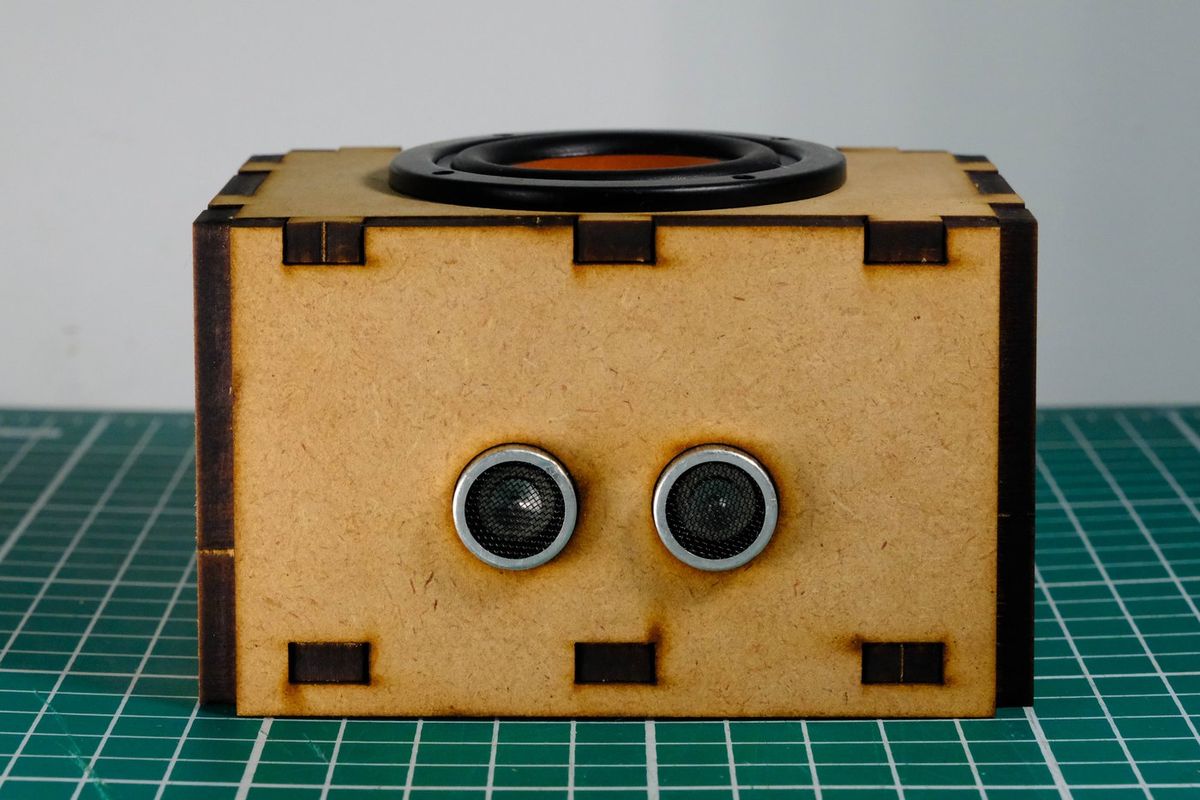
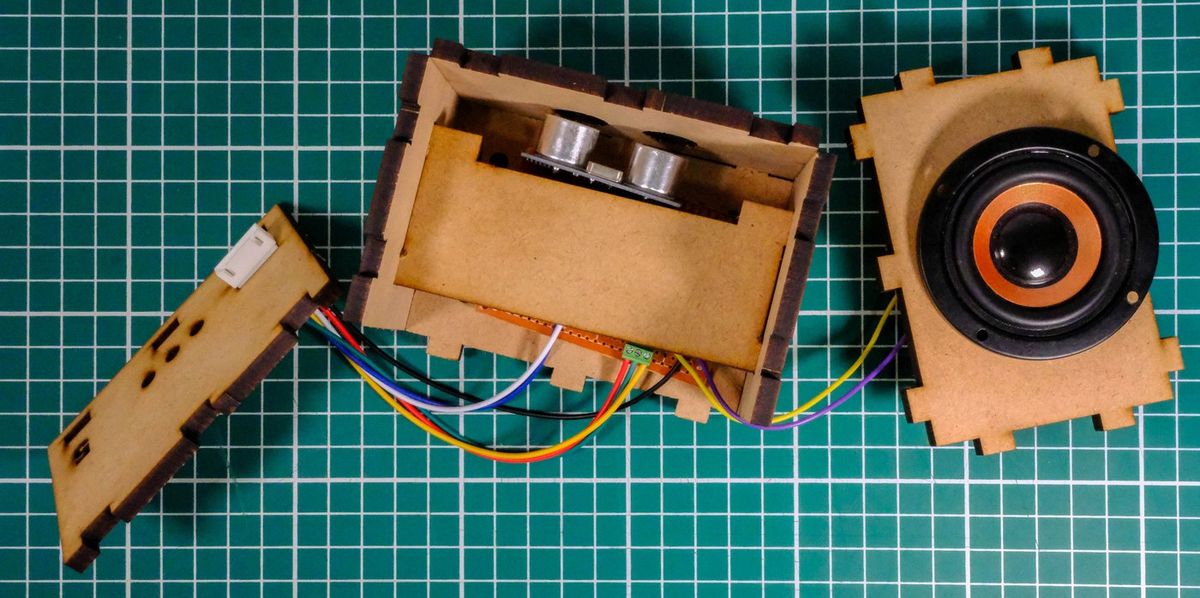
In the museum
Five laser-cut MDF boxes sit at the base of the painting, one per zone. The two “eyes” are an ultrasonic sensor that measures how far away the visitor is; a speaker sits on top. An Arduino reads the sensors and picks the voice.
In the simulator
The boxes are in the same place, at the base of the painting. Instead of the sensor, the ↑ ↓ arrows tell how far away the visitor is.
2. The coloured floor
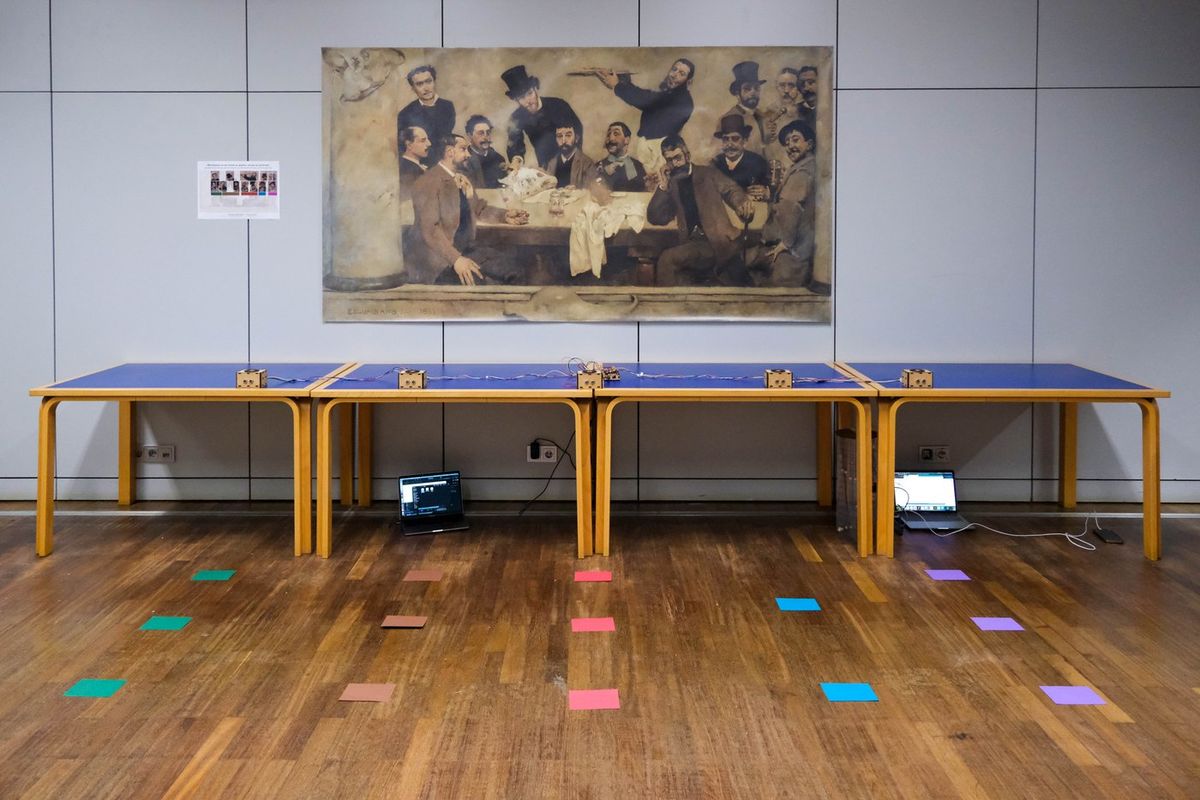
In the museum
Coloured squares mark the five zones and the three distances. The floor mirrors the painting: closer to the wall you hear the people at the front, further back the ones at the back.
In the simulator
It is the floor you walk on. Use ← → to change zone and ↑ ↓ to come closer, or the buttons on screen. The space view shows the whole floor from above, and you can tap a square to go there.
3. The label and the visitor
In the museum
On the wall, a label in the same colours as the floor says who is who. There are no screens or headphones: you just walk, and whoever is nearby hears the same.
In the simulator
The label is in the bottom-left corner and highlights the face of whoever is speaking; tap it to enlarge it. Drag to look around and turn on captions if you like.
Keyboard
- ←→
- change zone
- ↑↓
- come closer to or move away from the painting
- C
- turn captions on or off
- V
- switch between the space view and your own eyes
- Esc
- close the label or the panel, or skip the entrance
Results
The painting became an event.
The installation was tested with ten people, in two groups of five, in front of a reproduction of the painting. The first group used the version with no marks on the floor; the second, the version with the coloured floor and a label in the same colours.
-
Before: 1 of 5. After: 5 of 5.
discovered the three distances, once the floor was marked
-
Before: 4 of 5. After: 0 of 5.
complained about hearing two boxes at the same time
-
10 of 10
felt positive emotions, above all interest and amusement
“A living painting.”
“I felt transported to the scene, present at the moment the painting was made.”
“I think each one having a voice really helps to see them as individuals who existed.”
To know
One participant took a photo of the label and used it to find out, one by one, who each person was. They stayed for almost seven minutes.
To feel
Another participant didn’t look at the label at all and let the conversations carry her: she was listening 94% of the time.
Both ways of visiting worked. The biggest lesson came from the first test: for an invisible interaction to work, its limits have to be visible in the space.
Next steps: a sturdier circuit, sensors that also detect wheelchair users, and trying the idea with other works.
Credits
Project, design and sound
Felipe Rabaça Panichi Vieira
Supervision
Prof. Dr. Victor Manuel Marinho de Almeida
Voices
- Henrique Patrício
- Ribeiro Cristino, Rodrigues Vieira
- Carlos Martins
- Alberto d'Oliveira
- Gabriel Garanhão
- Manuel Fidalgo, João Vaz
- Dinis Ramos
- Columbano Bordalo Pinheiro
- João Sassetti
- José Malhoa, Diaz, Rafael Bordalo Pinheiro
- Vasco Carrilho
- Cipriano Martins
- Bernardo Gomes
- Henrique Pinto
- Guilherme Prata
- Silva Porto
- André Lourenço
- António Ramalho, Moura Girão
Fourteen voices recorded by nine Portuguese actors, free to improvise on the script.
The painting
O Grupo do Leão, Columbano Bordalo Pinheiro, 1885. National Museum of Contemporary Art (Chiado), Lisbon.
Context
Art Beyond Observation. Master’s final project in Interaction Design, Faculty of Architecture, University of Lisbon, 2025.
Come closer. They are talking.
Enter the room